

Unul din cele mai impresionante discursuri auzite in ultimul timp.
Mai ales ca vine de la un australian :).
Bloody true, mate. Bloody true...
:bow:
Citeste tot...
joi, 26 mai 2011
A balanced life
marți, 14 septembrie 2010

joi, 3 iunie 2010
Romania - Manual de utilizare
Dintr-o carte fascinanta: When Culture Collides - Leading Across Cultures, Richard D. Lewis; Nicholas Brealey International, 1996, rev. 2006, pp. 324 - 329
Despre Romania, despre specificul sau cultural, despre cum sa te porti cu romanii, despre cum sa faci afaceri cu romanii, despre cum sa profiti de slabiciunile si de orgoliile lor pentru a merge treaba mai bine si / sau a nu calca in strachini.
Repet: o carte fascinanta, care trece in revista (mai ales depedeve organizational / al relatiilor de afaceri) multe din tarile lumii.
Highly recommended. De citit cap-coada, de doua ori, if possible.
* * *
CULTURE
Values
Romanian values are largely forged in the crucible of an invasion-prone territory— the Ottoman Turks, Czarist (and later Soviet) Russia and the Austro–Hungarian Empire. Opportunism and maverick behavior have enabled Romania to survive as a state, its territory expanding and contracting periodically, depending on the success of its alliances. Such historical conditions and exigencies have led to anomalous positions on foreign policy. The enduring concept of Romania Mare (Greater Romania) may be less notorious than Milosevic’s concept of Great Serbia, but it exists in Romanian minds nevertheless.
Such a kaleidoscopic, complex historical background has led to Romanian values such as:
• obsession to survive pride in being a Balkan anomaly
• opportunism social corruption
• apostasy nepotism
• volatility self-importance
• unpredictability sense of the ridiculous
• tendency to blame others black humor
• evasive techniques of action
CONCEPTS
Leadership and Status
Romania is situated in the part of Europe that was inhabited by peasant masses, ruled for centuries by sovereign lords, clan leaders and autocrats. In the post- Ceausescu period, modern leadership styles are hampered in their development, since the government is still run by former communist leaders, who function under other labels. Business leaders are also affected by the continuing influence of the political apparatus. Romanian managers are gradually developing a style of their own that resembles that of Italian managers: autocratic but paternalistic and using emotion as a manipulative tool.
Space and Time
Romanians, though not on the Mediterranean, have the Mediterranean sense of space; that is to say, they like rubbing shoulders with people and are comfortable in groups or crowded conditions. They stand closer than Slavs, who require occasional moments of solitude. Romanians are not punctual in general, especially with each other. Meetings usually start 30–45 minutes late. If you are invited to a Romanian home, it is best not to arrive early or on time, as the hosts will not be ready.
CULTURAL FACTORS IN COMMUNICATION
Communication Pattern
Romanians are oratorical by nature (neighbors say “long-winded”) and are proud of their sophistication in discourse. They rarely answer questions with yes or no, so it is not advisable to ask direct questions requiring affirmative or negative answers. It is better to hint at what you want and then be prepared to read between the lines of their reply. Their answers are in any case long and complex and may to some extent reflect what you want to hear. Their delicacy is Italian in nature, as is their capacity for flexible truth when questioned aggressively. Their style of address is personal, and they seek your own opinion or support rather than that of your organization.
Listening Habits
Romanians are attentive but suspicious listeners, who may interrupt you if anything you say seems contradictory. They are used to lengthy presentations and arguments, so if you are too brief you will not make much impact. 
Behavior at Meetings and Negotiations
Several decades of communism and repressive centralized rule have bequeathed Romania with a poor commercial infrastructure riddled with bureaucracy and corruption. The Westerner, consequently, must be wary of the possibility of being cheated—a common occurrence in a region with a hybrid Balkan and Turkish historical background.
Romanians are skilled diplomats and negotiators, and hard bargaining faces any foreigners who wish to do business with them. You will have to be careful to distinguish between apparent prospects and factual reality. Deals are rarely a straight transaction between two parties. Others are likely to be involved on a commission basis, exacting bribes or demanding “facilitation” payments. When you sense this is happening, bring in a Romanian go-between. Such “transaction costs” are generally laid at your door as the foreigner, unless you maintain
vigilance.
It is important to establish parameters at the outset of any business discussion, fixing procedures, limits and ultimate positions. Romanians will not be deterred from attempting to gain advantage, but once they have understood your position, they can behave in a constructive, creative and charming manner.
At meetings, extensive small talk is a necessary preamble. Be wary of painting yourself into a corner at this stage. When the Romanians get down to business, their statements must be taken with a pinch of salt. If you disagree with them, show this obliquely, as they hate being snubbed in any way. Never tell them what to do—it would upset their superiority complex. In general Romanians are risk takers (Turkish influence), and they will work hard to close a deal once everyone is on the same track. They are actually more open with foreigners than with each other, often showing reticence in front of their compatriots (a legacy of decades of spying, informing and eavesdropping). With foreigners they show their desire to please, but watch out for their frequent defense: “But that won’t work in Romania.”
When things get bogged down, Romanians often come out with spontaneous (and apparently new) ideas. Although they are skilled negotiators, they often show little knowledge of Western exigencies, particularly with regard to speed, urgency or integrity.
Follow-through is not a Romanian strong point. When a deal is concluded, everything should be put in writing, witnessed by decision makers and the competent experts. After that, it is advisable to get further approval (in writing) from a very senior person in the organization. Romanians are often comfortable with ambiguity, whereas the Westerner wants final clarity. The communist legacy has left them with a poor sense of accountability, responsibility and best routes to the bottom line.
There may be attempts to alter conditions or clauses after the agreement has been signed. Such steps must be resisted unequivocally.
Manners and Taboos
Given its incredible ethnic diversity, Romania has an impressive storehouse of manners, customs, traditions, folklore and folk art. Romanians have the reputation of being excessively or embarrassingly hospitable. One Romanian writer describes this as “aggressive hospitality.” You have to be, for example, very careful not to “under-indulge” at a meal in a Romanian home or to refuse anything being offered. The only defense against Romanian hospitality is to reciprocate their generosity. Items from your own country are often most appropriate. Wellillustrated books, prints, quality pens, attractive stationery, ties, scarves and packaged foods (delicatessen) are appreciated. Some Romanians like good whisky or cognac.
Taboos include impolite or brusque behavior; blunt, direct remarks showing disagreement; and inquisitiveness as to personal details.
How to Empathize with Romanians
Romanians get on well with people who are happy to converse at length, especially about poetry, philosophy, history and the arts. Qualities they admire are erudition, delicacy of expression, intuition and compassion. Exchanges can be on a close personal basis, especially when you have attained a certain familiarity. Though more circumspect than Italians, Romanians resemble them in their desire for spiritual closeness, confidences and exploration of human feelings. The development of such relationships will make subsequent business dealings much easier to carry out, and, moreover, will lessen the likelihood of your being cheated.
Always keep the Romanians’ animosity toward Hungarians in mind, but Romanians suffer from a national persecution complex as a result of centuries of mistreatment by foreign conquerors. Suspicion is a national habit.
Finally, remember that at heart they are epicureans and want to have a good time with you.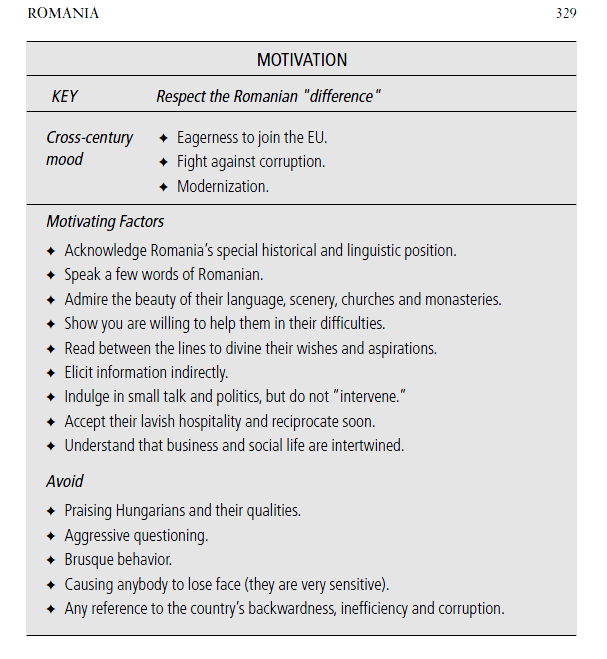
Citeste tot...
vineri, 25 aprilie 2008
Prime de prime
He. He he. In contecstu in care Cotidianu, in spirit creshtinesc shi deontologic, da din casa de la concurentza de la Oancea despre procedurile organizatzionale de motivare a angajatzilor cu ocazia sfintelor sarbatori de Pashti, sa va spui shi eu una.
Zice ca...
Zice ca.. O naiba de balauuurrr....
Nu. Asta este din alt film.
Ziceeee caaa. Zice ca un director de Sasu, dat fiind ca este la o oareshce stramtoriciune bugetar-financiara, nu prea are de unde sa dea prime angajatzilor TVR. Si atunci, intr-o genialitate organizational-motivatzionala, Sasu le'a grait asa: Bani de prime nu am sa va dau, dar va dau o zi libera in plus.
Doo kile de zi libera. Ramane asa sau mai punem?
rofl. E pe bune. Nu e cioaca. Nu e barfa. E crudul, purul shi tristul adevar. Nasol, nu?
Hai, Paste fericit, nemuncit si dedulcit! :)
Citeste tot...
luni, 14 aprilie 2008
Papucii asimetrici
Adica papucii de folosit intr-o relatie asimetrica. Cum ar fi, de exemplu, o relatie ierarhica. Profesionala. De la ala la alalant.
Da, da. It's fer yer bun's only. Tu, asta care citeshti acum.
Courtesy of Cristi, care incearca sa evite contactul.
:) Citeste tot...
miercuri, 2 aprilie 2008
luni, 17 martie 2008
Aaaaaarggggh!
Doamnelor si domnilor,
Read my lips:
Ma fuuuuuuutttt! Aaaaaaaaarghh! Vreau acasaaaaaa....
Doamnelor si domnilor, va multzumesc pentru rabdarea si amabilitatea aratata pe parcursul acestei iesiri necontrolate.
Ne vedem pe 16 iunie.
Aaaaaarghhhhh!!
:rant: :(
Citeste tot...
joi, 6 martie 2008
They've axed Cipriani
That's how things are done in civilised countries. You've done wrong, you pay.
This hot young Wasp fullback Danny Cipriani, who's on the verge of becoming a fully fledged member of the British Rugby team, stepped yesterday into a club around midnight, then accordingly stepped outside the team that will encounter Scotland this weekend in the Six Nations Cup. The coach gave him the boot and called a replacement, although this sorry fella Balshaw played miserably in both previous 6N games, with both Wales as well as with France.
That's why they've almost conquered this bloody world, these bloody arrogant Brits: discipline. Discipline and punishment. Where's my whip?
PS: Damn. I won't see this weekend games. I'll be in Lisboa. What a pity... :) :p
Citeste tot...
Corespondentza de lucru
Sefu (that would be me):
Imi bag p*la in ea de viata daca mai imi trimiteti inca o data, o singura data rapoarte cu greseli elementare de scris (litere mancate, inversate), va f*t muma in c*r si aveti 10% taiat la salariu, ca nu e normal sa fac eu pe secretara sa fac corecturi.
F*tuva muman c*r de neseriosi.
Cu stimǎ,
Al Dvs.
============
Angajatu (that would be her)
Stimate Dl. Director Executiv,
Va trimit in atasament raportul ultimului proiect realizat. Sper ca este in regula.
Dincolo de acest raport, inteleg nemultumirea dvs. in ceea ce priveste greselile aparute in rapoartele proiectelor realizate pana in prezent si mi le asum. Prin urmare, daca dvs. considerati necesara o sanctiune cu 10% din salariu nu am ce sa obiectez.
Totusi, tin sa va atrag atentia ca limbajul dvs. folosit in mailul anterior este un limbaj pe care eu personal il consider jignitor si nepotrivit pentru o persoana care doreste sa lase impresia unui profesionist care lucreaza intr-un institut de cercetare.
Atata timp cat cereti respect de la angajatii dvs. consider ca si dvs. trebuie sa le aratati un minim de respect si nu sa ii jigniti pe ei si familia lor.
Cu respect,
========
Sefu (that would be me again):
Stimata doamna,
Remarc in discursul Dvs. subit indignat o discrepanta de registru lingvistic ce se invecineaza cu ipocrizia. Pe de o parte, pe cale orala dati dovada frecvent in exprimarea Dvs de o coloratura expresiva baroca, informala si uneori in usoara contradictie cu umorile victoriene - ceea ce, sa nu ma intzelegeti gresit, va sta bine. Pe de alta parte, brusc si dintr-o data solicitati relatii principiale, bazate pe echitate, respect reciproc si alte sintagme lemnoase culese din Codul Familiei comunist.
Tin sa va precizez pe aceasta cale ca maniera de adresare, dupa cum stiti, este mai putin relevanta, mai ales in relatia noastra. Conteaza calitatea lucrului realizat, in cazul de fata cantitatea de greseli gramaticale pe hectar de pagina electronica.
In rest, ramane cum am stabilit. Mai gresiti rapoarte, o sugeti. Cu eleganta administrativa. Si Dvs, si colegul Dvs de cercel S. (transmiteti-i pe aceasta cale concluziile corespondentei noastre de servici). Daca iese bine, atunci toata stima si respectul. Imi retrag propunerea de felatie si dau o bere. Doua. Un whiskey.
Hai, pa. Am treaba: trebuie sa corectez greseli gramaticale.
Asigurandu-va de cea mai inalta consideratie umana, profesionala si culturala,
Si in acelasi timp reiterand propunerea mea ferma de corelatie dintre calitatea actului profesional si cantitatea de lichid seminal directionata energic spre Dept. Dvs.
Cu stimǎ,
Al Dvs.
=========
Nu-i asha ca viata e faina si plina de provocari de tip challenge? :)
Citeste tot...
Abonați-vă la:
Postări (Atom)


